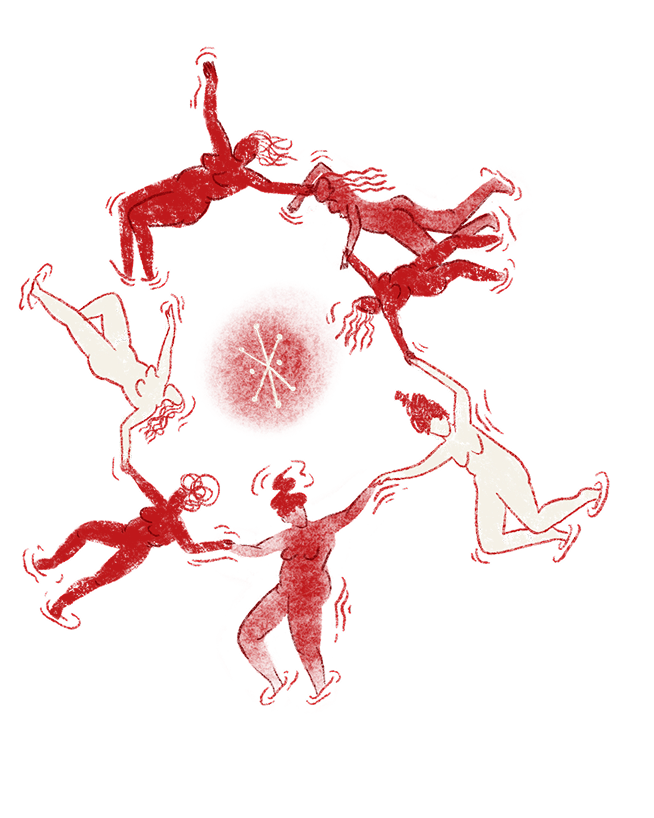
Unfreezing the Body — Watery Encounters
A set of embodied and water-based practices that invite participants to explore their relationship with the body and the Territory. Through movement, touch, reflection, and collective conversation, participants attune to the connections between extractivism, patriarchy, and the control of women's and feminized bodies, while cultivating embodied forms of relation grounded in pleasure, reciprocity, and cuerpo-territorio.
Tools
Re-storying from the Territory is a deeply emplaced and embodied practice — besides having impact on the lands and waters, extractivism also impacts and moves through bodies. The impact this activity explores is that on women’s and feminized bodies, which are often controlled, sexualized, disciplined, and treated as available for extraction in ways that mirror how extractive systems relate to the Territory itself.
Latin American feminist thinkers explore the alliance of extractivism and patriarchy in the reorganization of social life through the militarization of extractive zones, the arrival of predominantly male labor forces, the separation of productive and reproductive labor, and the intensification of violence toward women and feminized bodies. In these contexts, both bodies and Territories become treated as available, exploitable, and open for appropriation. The control of land and water is deeply connected to the control of bodies.
Within Indigenous and communitarian feminist struggles across Abya Yala, the inseparable relationship between body and land is often described as cuerpo-territorio: the understanding that body and Territory are deeply connected and shaped through shared histories of violence, care, resistance, and survival. From this perspective, reclaiming the Territory also requires reclaiming the body from extractive, colonial, capitalist, and patriarchal relations.
Unfreezing the Body – Watery Encounters invite participants to enter into embodied relationships with water as a living Territory (not a resource or a landscape!). Through floating, movement, touch, reflection, pleasure, and collective conversation, participants are encouraged to notice how extractive and patriarchal relations live within their bodies and shape their relationship to pleasure, intimacy, care, exhaustion, and vulnerability.
The activities also reflect on how rivers and women’s bodies have historically been similarly framed as excessive, available, wild, or open to conquest (in Loreto this is connected to the sexist stereotype of the Charapa Caliente). In the Amazon, rivers and forests have long been feminized through colonial and extractive narratives that position both nature and feminized bodies as territories to control, exploit, or discipline. Against these histories, the activities create space for participants to engage water differently: as relation, as collaborator, as memory, and as a source of embodied knowledge.
The practices are grounded in embodied attunement and in what Audre Lorde describes as the erotic: more than sexuality — a deep source of feeling, connection, information, and power. Participants are invited to cultivate forms of erotic relation rooted in care, reciprocity, pleasure, and embodied awareness as ways of challenging extractive and patriarchal world-making.