Learnings from the Chullachaqui
Many of the participants in the first iteration of the school, Norma, Almendra, Celia, Lida, Natalia, Sulyn, Gimena, Angela, Cynthia, and Andrea grew up with stories and encounters with the Chullachaqui. That being who transforms into someone you know, whether through familiarity or desire, to lead you into the jungle. Colonially, they say it was to rob you, but previously, it was to teach the importance of balance and reciprocity with the Territory. We prefer to stay with the latter, where the Chullachaqui recognized a pedagogical need to teach humans when they were taking in excess or without reciprocity.
Throughout the school, his presence was felt and pointed to as we walked in the Allpahuayo-Mishana forests and swam in the waters of the Nanay River. This begged the question: why are we summoning him through laughs and comments? What is he trying to tell us? To teach us? What can we learn from the Chullachaqui for re-storying extractive narratives?
Four orientations
Learning to Shift With Stories
Remaining Open and Responsive to the Not-yet
Speculating Otherwise Worlds
Knowing Territory Through Its Cracks and Shadows
Learning to shift with stories, and remaining open to the not-yet
Learning to Shift With Stories
Learning to Shift With Stories
From the Chullachaqui, we learn to develop a capacity for constant transformation by recognizing that we are hybrid beings, made of biology and story (Wynter, 2015), capable of unsettling the boundaries between man and woman, human and more-than-human, and many more.
The Chullachaqui's shapeshifting depends on understanding the personal story of the person or figure he shifts into; his transformations are never arbitrary. They invite us to notice how stories bind us to particular ways of seeing, feeling, and responding. His shapeshifting becomes a relational practice for inhabiting the porousness between stories and their matters.
Transformation also becomes a way of learning from others. If we transform into you, would we also be able to see from your perspective? Would we feel differently toward the world around us?
Learning to Shift With Stories
From the Chullachaqui, we learn to develop a capacity for constant transformation by recognizing that we are hybrid beings, made of biology and story (Wynter, 2015), capable of unsettling the boundaries between man and woman, human and more-than-human, and many more.
The Chullachaqui's shapeshifting depends on understanding the personal story of the person or figure he shifts into; his transformations are never arbitrary. They invite us to notice how stories bind us to particular ways of seeing, feeling, and responding. His shapeshifting becomes a relational practice for inhabiting the porousness between stories and their matters.
Transformation also becomes a way of learning from others. If we transform into you, would we also be able to see from your perspective? Would we feel differently toward the world around us?
Remaining Open and Responsive to the Not-yet
Remaining Open and Responsive to the Not-yet
Because the Chullachaqui transforms into whoever he needs to be at that moment, we learn a form of being that stays in motion and responsive to the reality that stories, like that of the human, are not settled facts but ongoing practices (Wynter & McKittrick, 2015). Practices that move us toward the uncertainty of the not-yet, where we loosen our attachment to fixed agendas and instead work with the “conditions to come” (Uncertain Commons, 2013 in Springgay & Truman, 2018, p. 208).
His speculative shapeshifting offers ways of moving with and beyond inherited stories toward ways of living that cannot be fully known in advance. This can be messy, unpredictable, and uncomfortable work. He reminds us that our form is versatile, that we are continually made and unmade through stories, relations, and encounters.
Remaining Open and Responsive to the Not-yet
Because the Chullachaqui transforms into whoever he needs to be at that moment, we learn a form of being that stays in motion and responsive to the reality that stories, like that of the human, are not settled facts but ongoing practices (Wynter & McKittrick, 2015). Practices that move us toward the uncertainty of the not-yet, where we loosen our attachment to fixed agendas and instead work with the “conditions to come” (Uncertain Commons, 2013 in Springgay & Truman, 2018, p. 208).
His speculative shapeshifting offers ways of moving with and beyond inherited stories toward ways of living that cannot be fully known in advance. This can be messy, unpredictable, and uncomfortable work. He reminds us that our form is versatile, that we are continually made and unmade through stories, relations, and encounters.
Speculating otherwise worlds, and knowing territory through its cracks and shadows
Speculating Otherwise Worlds
Speculating Otherwise Worlds
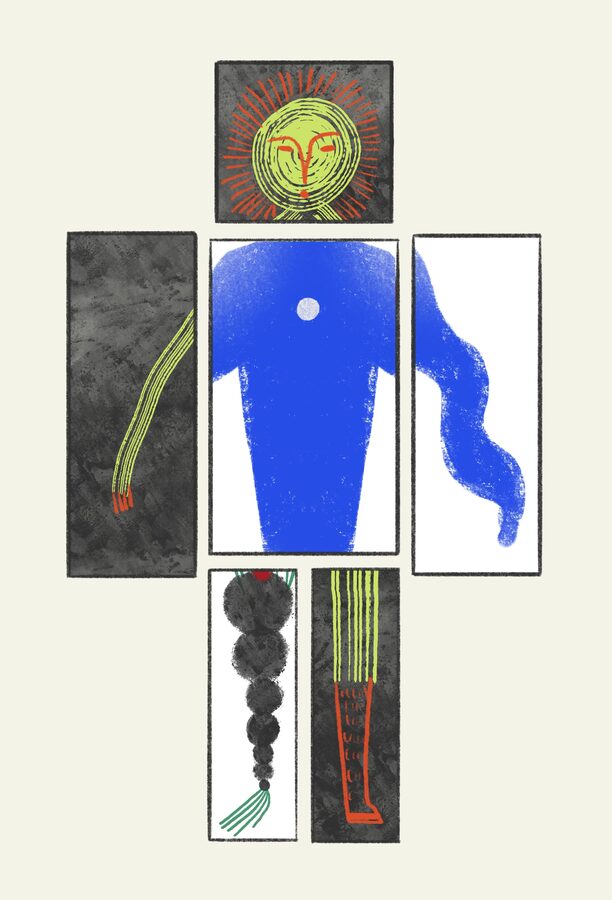
The Chullachaqui develops strategies that move between deception and seduction, play and pleasure, bringing humans into relationship with the more-than-human. These strategies work because he knows how to read spaces, desires, fears, and people speculatively.
His shapeshifting is itself a speculative practice, foregrounding a relational imagination that reaches toward what is not yet visible, felt, touched, or remembered (Pierce, 2025). From these teachings, we learn to dream, imagine, create, and re-create. We learn to experiment with strategies capable of transforming the historic storyworlds of extractivism and the relations they sustain.
The Chullachaqui is a being who experiments with form, perception, movement, and relation. A being who understands transformation as something lived collectively, affectively, and materially. And at the same time, he is an educator. His shapeshifting teaches through encounter, sensation, confusion, desire, and attention.
The Chullachaqui reminds us that we, too, are both artists and educators. That creating spaces for re-storying extractive worlds requires pedagogical and artistic practices capable of opening relations, unsettling habits, and rehearsing other possibilities for living within damaged worlds.
Speculating Otherwise Worlds
The Chullachaqui develops strategies that move between deception and seduction, play and pleasure, bringing humans into relationship with the more-than-human. These strategies work because he knows how to read spaces, desires, fears, and people speculatively.
His shapeshifting is itself a speculative practice, foregrounding a relational imagination that reaches toward what is not yet visible, felt, touched, or remembered (Pierce, 2025). From these teachings, we learn to dream, imagine, create, and re-create. We learn to experiment with strategies capable of transforming the historic storyworlds of extractivism and the relations they sustain.
The Chullachaqui is a being who experiments with form, perception, movement, and relation. A being who understands transformation as something lived collectively, affectively, and materially. And at the same time, he is an educator. His shapeshifting teaches through encounter, sensation, confusion, desire, and attention.
The Chullachaqui reminds us that we, too, are both artists and educators. That creating spaces for re-storying extractive worlds requires pedagogical and artistic practices capable of opening relations, unsettling habits, and rehearsing other possibilities for living within damaged worlds.
Knowing Territory Through Its Cracks and Shadows
Knowing Territory Through Its Cracks and Shadows
The Chullachaqui is bound to his Territory. He knows how to transform because he knows the Territory intimately, both in the light and in its cracks and shadows. He maps beyond the human, carrying the memories of the forest, rocks, waters, birds, and many other beings.
From him, we learn that knowing Territory goes beyond physical boundaries, as we move to listen to the affective, historical, and relational life of place. To know a Territory requires attending to what hurts, what flourishes, what has been silenced, and what continues to insist on being felt.
The Chullachaqui's movements remind us that transformation is inseparable from emplacement. The ability to shift, speculate, and teach comes from being deeply entangled with the places that shape us.
We are not claiming we can become Chullachaquis, we do not have his consent. But we can learn from what he has taught others. His teachings invite us to reflect on who we transform into when creating spaces to re-story extractivism's storyworlds. Who do we become in order to learn from other spaces, relations, and beings? What speculative strategies can we cultivate for living differently within damaged worlds? How do we come to recognize our Territory, and ourselves within it?
These questions remain unfinished because shapeshifting is ongoing. Our re-storying as pedagogy-as-art continues unfolding through practice, conversation, experimentation, and relation. Is part of the deal for re-storying a life-affirming world, where the sensing of possibilities already and soon-to-be moving beneath the surface of the worlds we inhabit is a labor of forever-now.
Knowing Territory Through Its Cracks and Shadows
The Chullachaqui is bound to his Territory. He knows how to transform because he knows the Territory intimately, both in the light and in its cracks and shadows. He maps beyond the human, carrying the memories of the forest, rocks, waters, birds, and many other beings.
From him, we learn that knowing Territory goes beyond physical boundaries, as we move to listen to the affective, historical, and relational life of place. To know a Territory requires attending to what hurts, what flourishes, what has been silenced, and what continues to insist on being felt.
The Chullachaqui's movements remind us that transformation is inseparable from emplacement. The ability to shift, speculate, and teach comes from being deeply entangled with the places that shape us.
We are not claiming we can become Chullachaquis, we do not have his consent. But we can learn from what he has taught others. His teachings invite us to reflect on who we transform into when creating spaces to re-story extractivism's storyworlds. Who do we become in order to learn from other spaces, relations, and beings? What speculative strategies can we cultivate for living differently within damaged worlds? How do we come to recognize our Territory, and ourselves within it?
These questions remain unfinished because shapeshifting is ongoing. Our re-storying as pedagogy-as-art continues unfolding through practice, conversation, experimentation, and relation. Is part of the deal for re-storying a life-affirming world, where the sensing of possibilities already and soon-to-be moving beneath the surface of the worlds we inhabit is a labor of forever-now.